Daniel O’Connell — Ireland’s First Populist Politician
Before we start, I should admit something. At first, I viewed Daniel O’Connell with suspicion, seeing him through a dark lens of populism. A loyalist to the British Crown and one of Europe’s first mass politicians, I thought his failure to win popular leadership across Ireland was just a matter of bad timing and circumstance. After all, history’s worst tyrants have learned from the lessons of their forebears.
I compared his tactics to those of modern populist leaders; how they wield national identity and religion to mobilise the masses and whip their followers into a frenzy; how they leverage soaring rhetorical skills to reach the hearts and minds of those who are simply desperate for someone to tell them that yes, there is legitimacy in what they believe, even though none may dare say it; how they form a movement that targets not only a subsection of society but one that spans the class hierarchy — from the poorest to the richest. Daniel O’Connell did all of these things. As have many other leaders throughout history and into the present day. Although we mustn’t tar every populist politician with the same brush, it is fair to say that many — if not most — tend to set aside whatever principles they might have once held in the pursuit of power; more importantly, in its retention. It is also fair to say that O’Connell, at times, teetered over the edge of this precipice, as many of his more ardent critics will readily tell you.
I am, however, a romantic at heart, and upon deeper research, I have discovered — by my lights, at least — a man of an altogether different paradigm. A man who, although controversial to some for his alignments and opinions, sought this type of popular power simply as a means to an end. A man who could be principled to a fault. A man who fell so deeply in love that it cost him nearly everything. Let us now take a look at O’Connell’s life along already well-trodden paths — and, perhaps, some a little bit less so.
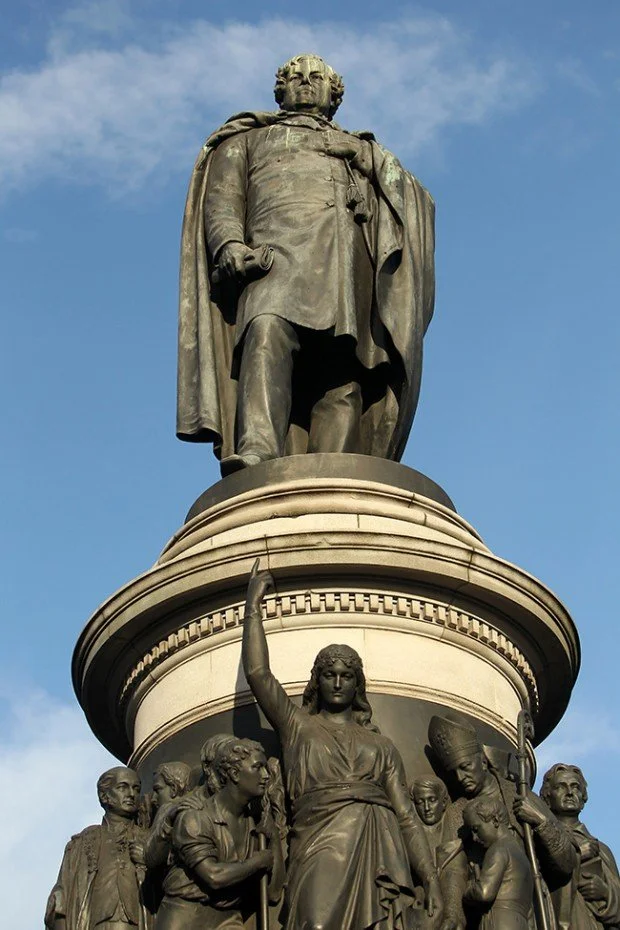
O’Connell’s monument on O’Connell Street, Dublin
Known in his time by many a soubriquet, including “The Liberator”, “The King of Ireland”, and at one stage even “The King of Beggars”, Daniel O’Connell was born in 1775 to a landed Catholic family in Carhan, County Kerry. In line with Gaelic tradition, O’Connell spent the first four years of his life in fosterage with the family of a local herdsman. Then, at the age of five, he was adopted by his wealthy uncle, Maurice “Hunting Cap” O’Connell, and moved to Derrynane House to live with him. His uncle became his patron, and their relationship — albeit stern and increasingly fractured as the years progressed — would prove foundational in O’Connell’s life.
As was also customary for the young sons of wealthy Gaels, O’Connell — along with his brother, Maurice — was sent to France to study in Douai via St. Omer. It was in Douai that O’Connell displayed a sharpness and aptitude that earned him the high regard of his superiors, who would declare him “destined to make his name as a remarkable public man”.
But the O’Connell brothers were not long for the continent. They had arrived in France on the eve of the Year of Terror, with political tensions at a boiling point. The ferocity of the ongoing revolution forced both young men to flee the country in January 1793. This formative experience would shape O’Connell’s view of the world, and he would later attribute his lifelong disdain for violence, bloodshed, and militant republicanism to the “sanguinary excesses” he beheld there. In 1794, thanks to some relaxation of the Penal Laws, O’Connell began his studies in law at Lincoln’s Inn in London. In 1798, he was called to the Irish Bar.
O’Connell enjoyed tremendous success as a barrister. Said to have earned more than £6,000 (approximately £300,000 today) per year, he was reportedly the highest-paid legal practitioner in Ireland. His voice was one of “sweet persuasiveness” and gave him complete control over an audience. Here, undoubtedly, is our first brief glimpse of O’Connell the populist — of how he could use his razor-sharp oratory to will his listeners to his point of view. He was ruthless in cross-examination and refused to pay the deference traditionally afforded to the courts. Yet another tenet of the populist leader: the outright dismissal of elite social structures.
His success, however, would not be without its difficulties. His surplus of cash led to unfettered spending and generosity towards his friends and family; although he was highly financially successful, these habits kept his income and expenses consistently neck-and-neck. This quirk of O’Connell’s personality would become a major issue when he married his cousin, Mary O’Connell, in 1802. In secret, mind you — for fear of unwelcome familial opinions, though not the ones our modern minds might spring to. Re-enter O’Connell’s uncle and benefactor, Maurice. Intent on securing the family’s financial and social position, he had long believed that O’Connell’s only true course was to marry an heiress. When he finally learned the truth, almost a year after the wedding, he was livid. Mary, daughter of the long-deceased Thomas O’Connell of Tralee, had not even arrived with a dowry! What nerve.
Hunting Cap’s retribution was “immediate and financially severe”. Once the sole inheritor of his uncle’s estate, O’Connell was now forced to split it three ways with his two brothers, James and John. To add insult to injury, John was duly elevated to the role of “favourite”, shunting O’Connell from the top of the podium, a position he had enjoyed since childhood. Nephew and uncle remained estranged for two years, and although they reconciled in 1805, their relationship would never be the same.
However, trials and tribulations borne of Mary and Daniel’s decision to elope as they did appear to have been, ultimately, worth it. By all records, they enjoyed a long and happy marriage that lasted until her death in October 1836. Though their early years together were beset by financial difficulties and long periods apart — primarily due to O’Connell’s burgeoning legal career and later his time in Parliament — their love story survives to us today in over 1,000 letters between them. Said to have been a “stabilising influence” on our subject, Mary was the only person to whom he could “truly confide his triumphs and misgivings”. When Mary eventually passed away at the age of 56, O’Connell was heartbroken. He described her as “the comfort and soother” of his cares, and never fully recovered from his loss. They had seven children together.
But we’re getting ahead of ourselves. Let us rewind a few salient years, because we are about to dive into the period of O’Connell’s life when he begins to truly demonstrate his propensity for popular politics. No doubt partly spurred by his exclusion from the upper echelons of British law because of his Catholic faith, O’Connell’s first foray into the public sphere came in 1800, when he delivered a scathing speech opposing the proposed Act of Union, which sought to abolish the Irish Parliament. In this speech, he set out his position: that Ireland’s historical and legal rights as a kingdom were unquestionable, and that no individual or political group, at home or abroad, had the right to annul them. In his own words: “If the alternative were offered him of union, or the re-enactment of the penal code in all its pristine horrors, he would prefer without hesitation the latter, as the lesser and more sufferable evil”.
Powerful though these words might have been, they could not withstand the power of the British Parliament. The Act of Union was passed in 1801, dissolving the Irish Parliament, and Westminster took full control of the country. Even so, O’Connell had done something noteworthy: he had taken his first step into the public eye and shown the people of Ireland what a future leader might look like. Over the next two decades, he would balance his career as a barrister with work within the Catholic community, remaining steadfast in the philosophical principles of civil equality and individual liberty that he had become familiar with during his time in France and London — the same principles that largely underpinned his future political positions. Much of his labour at this time was directed towards dismantling what remained of the Penal Laws, a series of legal disabilities imposed on Roman Catholics and Protestant dissenters, with the explicit intent of disenfranchising them. This endeavour took the form, first and foremost, of Catholic Emancipation: the right of Catholics to sit in Parliament and hold high public offices.
Unhappy with the meagre progress made while working with the small cohort of noblemen and middle-class professionals he ran with, O’Connell realised in 1823 that the base of support for such an action would need broadening. A display of “people power” was required, one that could draw on the strength of the entire nation — from the landed aristocrats to the “poorest class of tenant farmers". And so Ireland’s first national, organised, and disciplined political and populist movement was founded: the Catholic Association. The Association, in time, would undoubtedly prove to be the unifying force O’Connell had hoped it would be.
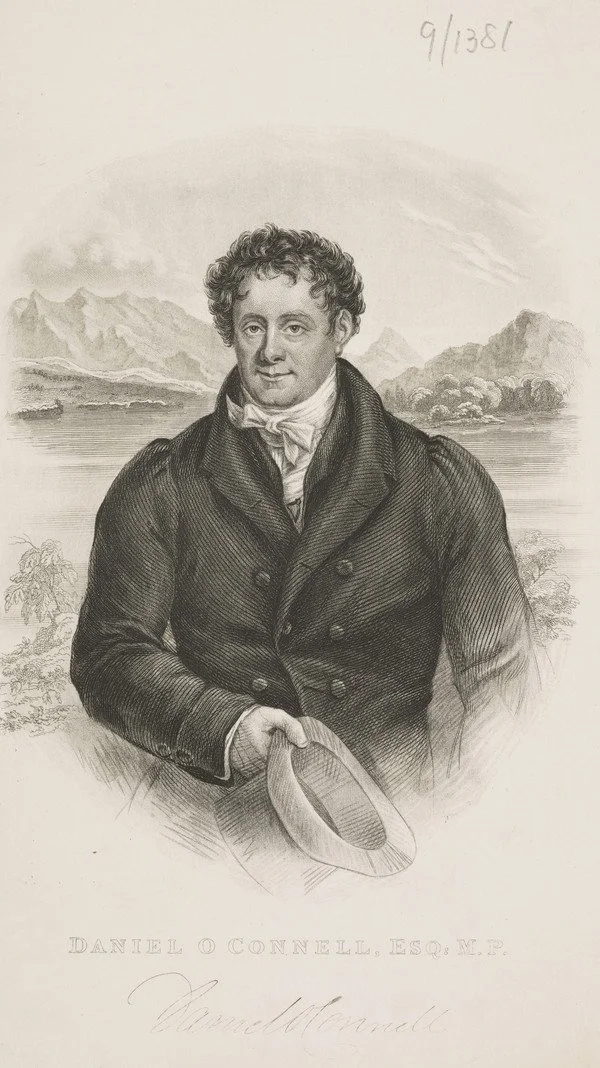
A pencil drawing of O’Connell from the National Galleries Website
Shot through the entire initiative was O’Connell’s well-known hatred of violence. "No political change is worth the shedding of a single drop of human blood", he is quoted as saying, and this mindset was clearly reflected in his staunch disapproval of the violent, albeit ill-fated, uprising staged by the United Irishmen in 1798; although, in true populist fashion, he would later in life claim to have been a member of the same organisation. When Robert Emmet renewed the revolt in 1803 against the now-United Kingdom Crown and Parliament, O’Connell publicly declared that he had “forfeited all claim to compassion” due to his role in the bloodshed, and even, contradictorily, called for his hanging. This stripe of non-violence is what gave O’Connell the uncanny ability to muster the people of Ireland to his cause — by providing them with a peaceful, legitimate, and constitutional outlet for their grievances. By doing so, he hoped to steer the people away from the "counsels of violent men" and, by showing them this alternative, blunt the potential of radical groups that acted as a counterforce to his own movement. Another resoundingly populist strategy, one might argue.
If the Catholic Association were to succeed in this manner, however, O’Connell and his compatriots would need funding. So was born the “Catholic Rent”: one penny a month was all he asked for — a sum paid easily by even the lowest pauper amongst the populace. Those who were better off might even contribute up to a guinea (twenty-one shillings). This not only endowed the campaign of emancipation with a vast treasury but also instilled in its cross-class contributors a sense of ownership and involvement, driving the popular movement with a power not of militancy but of a ”moral authority of an awakened democracy”. The Association used these funds to mount the “monster rallies” for which O’Connell would later become famous. Moreover, he chose to collect this rent through local clergy, thereby further enshrining his authority and trustworthiness and enabling him to maintain the discipline and control over his followers that he desperately needed. He needed them to remain non-violent and orderly if the British Government were ever to take their movement seriously.
The Catholic Rent was a massive success. Although his detractors would bestow upon him the aforementioned moniker of “The King of Beggars”, even the Duke of Wellington would later recognise it as a “vast demonstration of populist political organisation” and declare it more challenging to the United Kingdom than a secret conspiracy.
The ensuing years, no doubt, passed in a frenzied blur of political rallies, bitter polemics, and personal devastation. Having travelled to London in 1825 with the express intent of protesting Goulburn’s Act — a law that would prohibit political parties from existing for longer than fourteen days — O’Connell found himself mired in controversy when he threw his support behind a separate Catholic Relief bill proposed by Sir Francis Burdett, which ultimately failed to become law. Goulburn’s Act, however, passed. Although O’Connell would use his legal expertise to devise workarounds and continue the Catholic Association’s mission, its temporary dissolution and his perceived betrayal of the “forty-shilling freeholders” were exploited by his enemies at home to exact scathing criticism. They claimed he had sacrificed his followers' well-being for his own political gain. It was a misstep he would quickly recover from. Still, the aftertaste it left in the mouths of those who might have had doubts about O’Connell’s conventional approach to reform surely influenced the events that would unfold in the succeeding decade, as we shall soon see.
That same year, Maurice “Hunting Cap” O’Connell, his former benefactor and semi-estranged uncle, would, sadly, pass away. The man never did get around to reverting his will to its original form, reconciliation or no. At this point in his life, O’Connell’s political star was on a meteoric rise, and although he remained a dogged and incorrigible spender, his fiscal concerns were practically non-existent. Still, one cannot discount the tremendous impact a loss of such magnitude would have on a man as idealistic as O’Connell. To lose his father figure at what was arguably the apogee of his career was surely a terrible blow.
However, greater things, it transpired, lay just over the hill. In the 1826 general election, the Wexford results were to be a prophetic straw in the wind. Lord George Beresford, the incumbent member of Parliament and a pillar of the Protestant establishment, ran against his liberal counterpart, Henry Villiers Stuart. It was a stunning upset — one that proved not only the power of the Association but also the Catholic electorate’s fresh willingness to defy their landlords’ instructions. This victory would set the scene for 1828, when the Association would finally realise O’Connell’s vision of reform-from-within, forcing both the British Parliament’s hand and the issue of Emancipation.
Early that same year, a hard-line government led by the Duke of Wellington and Robert Peel took office. Although the Clare MP, William Vesey Fitzgerald, was a popular, pro-emancipation landlord, his decision to accept a cabinet position in the new government led to his disavowal by the Association, which had adopted a blanket stance of opposition to the new ministry. Who, then, would the most powerful political machine of its time throw its support behind?
Of course, they called upon O’Connell, and he won a decisive victory which precipitated a constitutional crisis. His attempt to take his duly won seat would be blocked, however, due to his refusal (nay, inability) to swear the Oath of Supremacy required of members of Parliament — an oath that would see him swear his allegiance to the Church of England. The Irish people grew angry at this injustice. Had they not, in accordance with the rules set down by London, fairly chosen their representative? Had they not done everything asked of them? Eventually, in fear of a bloody revolt, Prime Minister Wellington would plead with King George IV to change the law and allow O’Connell to take an oath that would serve both his kingdom and his faith. In 1829, the Catholic Relief Act was passed, putting to rest the final remnant of the Penal Laws.
Such is the power of the popular politician. One can’t help but marvel at the breadth of control O’Connell held over the masses at this moment, wielding the throngs like a threatening cudgel raised overhead, primed to strike. Would he have taken the swing? Or would he have kept to his professed abhorrence of violence? It wouldn’t be long before, once again, O’Connell found himself face to face with such a question, and it's here that we shall see the true nature of his character bear out.
The Roman Catholic Relief Act would not be retroactive, and forced O’Connell to stand for election once again that same year. Finally, in 1830, having returned unopposed, he took his rightful seat in the House of Commons — the first Irish Catholic to do so. This grand event would mark a new phase in his career, in which he turned full-time to his role as a parliamentarian and left his life as a barrister behind him. He quickly cemented his international reputation as a radical and an ardent advocate for civil and religious liberties. During his seventeen years as a member of Parliament, he championed many causes, including the abolition of slavery and the death penalty, universal suffrage, the Reform Act of 1832, and campaigns for the rights of the most disenfranchised across Europe and the greater British Empire. In 1835, he entered into an informal alliance with Lord Melbourne's Whigs — known as the Lichfield House Compact — to keep the Tories out of power. This shrewd political manoeuvre resulted in sweeping administrative changes and allowed the recruitment of Catholics into the police and the judiciary — another bloody nose to Catholic oppression in Ireland.
But all of his efforts would pale in comparison to the monumental undertaking he had initially set out to achieve — the repeal of the Act of Union, and the re-establishment of an Irish Parliament. Though the campaign had largely taken a backseat over the course of the 1830s, O’Connell renewed its push in 1840 with the relaunch of the Loyal National Repeal Association. The campaign reached a fever pitch in 1843 — known as the “Repeal Year” — with a series of the very same “monster meetings” O’Connell had become so well-known for. The most famous of these meetings took place at the Hill of Tara, which reportedly attracted nearly one million people.
This repeal campaign, a seemingly unstoppable locomotive barrelling towards Irish political independence, would face a major inflexion point in October of that same year. In what can only be described as the inevitability of populism, O’Connell’s rhetoric and perspective were becoming increasingly militant — something the Peel government was increasingly cognizant of. And so, they banned a scheduled meeting in Clontarf, deploying troops to the island to uphold the ruling. O’Connell’s followers looked to him for a response. Would he give the people what they wanted? Was this the time when, in his own words, his followers would “have the alternative to live as slaves or to die as freemen”? Would he go down in history as the leader of a violent revolution, one such as those he purported to detest so venemously?
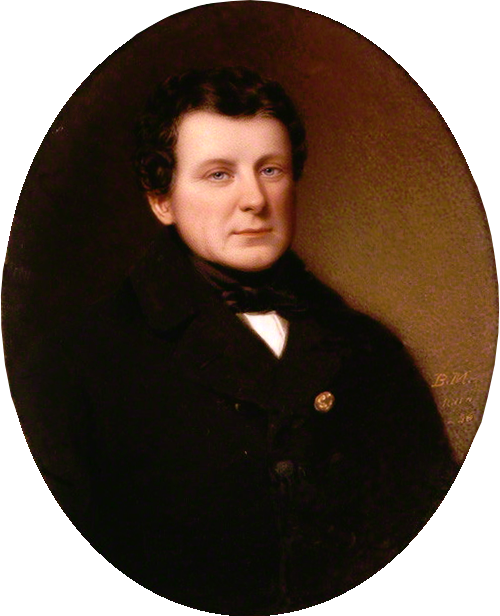
Daniel O’Connell, by Bernard Muirenin
Many populist leaders would have done just that. O’Connell, however, was not like many populist leaders. He remained true to his principles, cancelling the rally to avoid almost certain bloodshed. This decision would cost him dearly. Not only was he imprisoned by the government in 1844 on charges of conspiracy (charges that were quickly quashed on appeal), but the perceived obsequiousness he had paid towards the British government irreparably damaged his prestige among his followers — most notably the Young Irelanders, a subsection of the Repeal movement that had become increasingly influenced by the “insurrectionist” ideals of groups such as Guiseppe Mazzini’s Young Italy. This disillusionment within the movement was a devastating blow, shattering O’Connell’s “aura of invincibility”. Never again would he wield the power of the masses as he had in 1843, when he chose his conscience over the bloodthirst of the short-sighted. O’Connell had failed, and the Act of Union would remain firmly in place until Ireland achieved independence in 1922.
A myriad of factors have been attributed to the decline in O’Connell’s health between the early 1840s and his death in 1847. According to historical sources, the official reasoning was a “softening of the brain”. One could, however, posit that it was also a hardening — and subsequent breaking — of his heart. Having lost his beloved wife Mary not ten years prior, his imprisonment took a terrible toll on his health and was said to have never fully recovered from the experience. Perhaps this was only exacerbated by what he doubtlessly perceived as the utter shattering of his world-view, one that had come so close to achieving what it had set out to. In the end, he faced not only the rebuke of the State he had striven so hard to reach an accord with, but also of the people he had hoped to lead towards self-governance. Worse still, the Great Famine of 1845 was said to have left him a “broken man”, and “oppressed with grief”. His final speech to the British Parliament was a desperate plea for relief for the people of Ireland. No longer able to summon the same rhetorical power he once exerted, how words fell softly upon the unbothered ears of the House of Commons, many of whom had little concern for the affairs of the Irish. Observers who did sit up and attempt to listen noted that he was but a dim shadow of his former self. O’Connell set out on a pilgrimage to Rome in March of 1847. Two months later, having reached Genoa, he passed away.
I’ve struggled to find a satisfactory ending to this admittedly brief summary of Daniel O’Connell’s life — perhaps because there was little to be found in his own demise. What I did find, however, was that although one could describe O’Connell as a strident populist, it would be wholly unfair to rank him alongside some of the lesser-admired politicians who have given the word such a negative air over the last two hundred years. National identity, religion, mass mobilisation, and powerful rhetoric — all tools used by populist leaders, not least of all O’Connell. Where he seems to have differed from some of history's greatest villains, however, was that rather than leverage these tools for selfish and bloody ends, O’Connell used them to attempt to lift the boot from the neck of an island of millions (although some might argue merely a subsection), one that had been pressed there for generations. He was, of course, far from perfect, as we all are, but it appears to me that he was a man of principle, and that, at least, is something to be admired.
There is some evidence that some of his monikers might have gone to his head and tempted him in all the wrong directions — “King of Ireland” was surely an attractive title in a time of monarchs, kingdoms, and empire. Perhaps temptation might have crept up on him during his quieter moments, urging him to take his nickname and make it a reality. But his ultimate loyalty, it seemed, would rest not with any egomaniacal whims that might have struck him — ones that undoubtedly have so many others — but with his faith and with the people of Ireland. Right down to the end of his days at the age of seventy-one.
"My body to Ireland, my heart to Rome, my soul to heaven." — Daniel O’Connell