The Dichotomy of Control
Lately, I’ve been feeling mired in what I can only describe as a quagmire of world-changing events. The order that we’ve all taken for granted for so long is being dismantled right before our eyes. And we — being the discerning consumers of current affairs and news that we are — have front-row seats to it all: every corrupt transaction, every norm-breaking act, every blatant lie that sends a shiver down our spine and makes us nostalgic for a time when the most outrageous thing a politician did was wear a tan suit, or gather during the COVID lockdown. It’s all laid bare, out in the open, presented for our consumption by a media weaponised to drain us of our attention and time in exchange for ad-views and clicks.
Needless to say, the whole situation has been making me anxious. I haven’t been sleeping well. At night, I find myself spiralling into thoughts about possibilities and potentialities far beyond my control: Europe at war, a multi-polar world of authoritarian spheres of influence, and global economic collapse, to name just a few. I’ve even started learning how to grow my own vegetables — such is my concern for the stability of our supply chain.
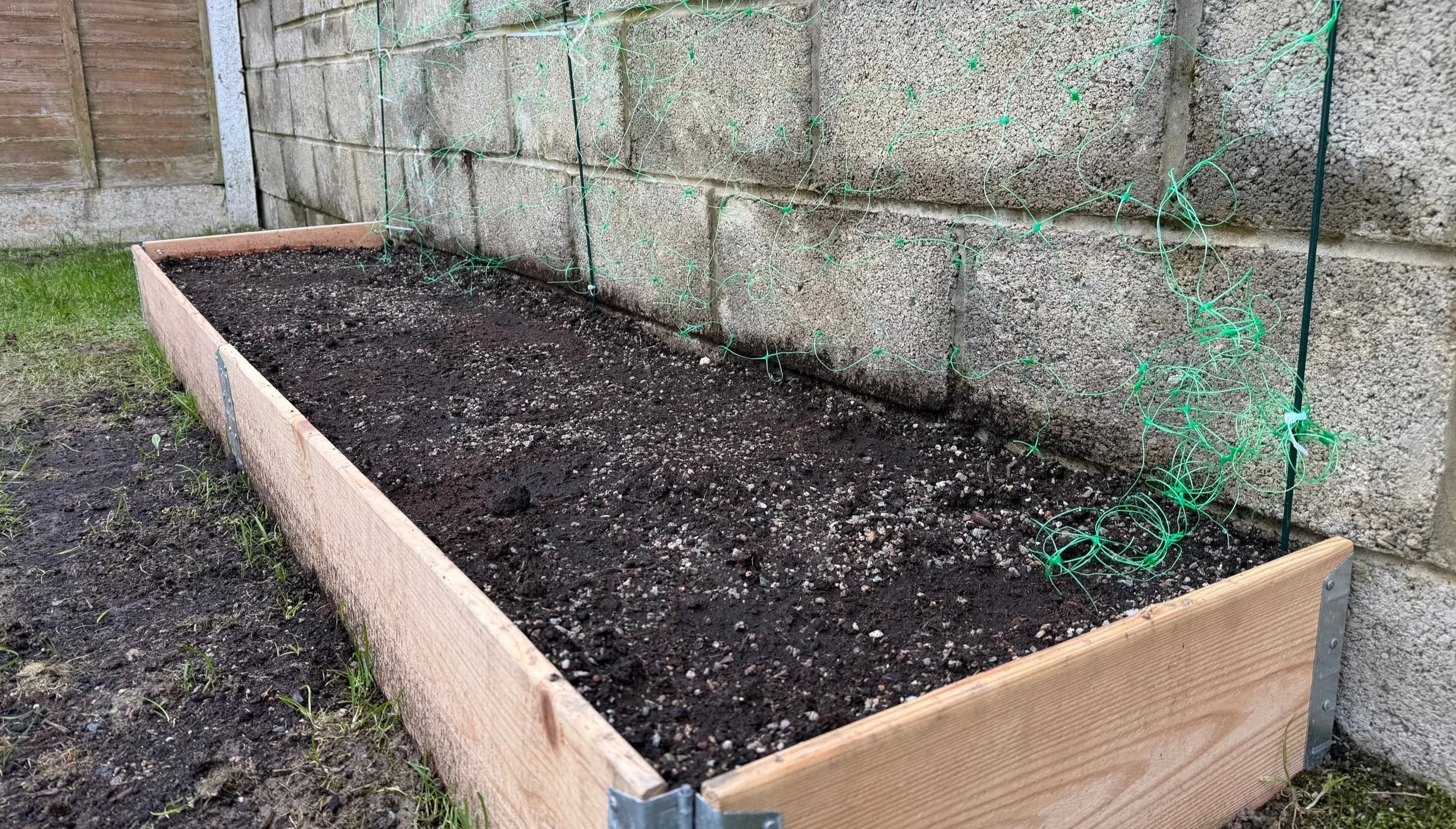
My burgeoning vegetable patch
Which, I suppose, leads me nicely to the topic I wish to write about today. Specifically, the opening line from Epictetus’ Enchiridion (or Handbook). It’s quite pithy, but its spirit is not only a foundational principle of Stoic philosophy but also of the schools of thought that underpin many of our contemporary psychotherapeutic and mental health practices. Are you ready?
“Some things are up to us and some things are not.”
This quote captures what, in Stoic philosophy, is called the “Dichotomy of Control”. While the main idea requires little explanation, perhaps you’ll indulge me. Put simply, its core principle is that everything in life can be divided into two categories: things within our control and things outside our control. Pretty straightforward, right? Focus solely on the things we can influence, as Epictetus urges us, and you’ll be free from the same anguish that afflicts those attempting to bend the world to their will. After all, our attitude towards things shapes how we experience them. As Marcus Aurelius writes in his Meditations: “External things are not the problem. It’s your assessment of them. Which you can erase right now.” Events are neutral; it’s our response to them that determines our overall experience.
I think we can all agree, however, that in practice, this concept is much harder to grasp than it initially appears. It’s easy to tell yourself that there’s little point in worrying about the cost of living if you can't do anything about it — but prices continue to rise, and money grows ever-tighter. Global tensions remain high, sowing a low-level uncertainty and fear that infects all aspects of our day. The madmen in charge are waging needless, brutal wars, threatening our very way of life, regardless of where we come from. All of these things have practical, tangible effects.
The point I’m trying to make here is that when sentiment, emotion, and real-world impact enter the mix — as they inevitably will — the distinction between what we can and cannot influence becomes blurred. American theologian Reinhold Niebuhr even composed a prayer about this very challenge, one that has been embraced by sobriety fellowships worldwide. The Serenity Prayer, as it’s known, reads as follows:
"God, grant me the serenity to accept the things I cannot change,
Courage to change the things I can,
And wisdom to know the difference."
It would seem, then, according to Niebuhr, that our understanding of what is and isn’t within our control must reside within the divine. Far be it from me to attempt to dissuade anyone from their beliefs. If trusting in providence helps bring you clarity, I would hardly suggest you do otherwise. Much like the ancient Stoics, however, I feel that a more concrete framework — one that helps me identify the things I can actually influence without awaiting inspiration from on high — is essential.
In his Enchiridion, Epictetus goes on to say that “Up to us are opinion, impulse, desire, aversion — in a word, whatever is our own doing.” This highlights the fundamental aspect of the Dichotomy of Control, where one side of the wall represents our inner world — our thoughts, actions, intentions, and choices. What is on the other side? Well, pretty much everything else. How other people behave, what they think of us, the events happening around the world, and the various outcomes that follow — we ultimately have little to no influence over any of it. Sure, we can pull some levers, flip some switches, but in the end, it’s all out of our hands. Our precious time and sanity are far better spent on bettering ourselves, the lives of our friends and family, and our community. Herein lies the real way we can make a difference in this world.
And yet, there is still more complexity to consider. Even the things that Epictetus claims belong to us can often slip our grip: emotions that surface unbidden, intrusive thoughts that clash with our character or beliefs; unexamined and automatic behaviours that lead us down a path of self-destruction; even our physical health, when the day is done, remains firmly on the "not up to us” side of our wall. The realisation that we have so little control over the world is a sobering one.
How then are we to live any sort of life, let alone a virtuous one? How do we quieten our flaring tempers, our stoked passions? How do we disable the cruise control that chooses our actions for us and rationalises them however it sees fit?
I’ve spoken before about phantasiai: our first impressions of things. These impressions are automatic, ingrained in us through a combination of nature and nurture, and are often less than comprehensive in their perspective. Only after we have examined these phantasiai should we grant — or withhold — assent to them.
To posit an answer to our earlier question about how we gain control over our emotions: we allow ourselves to feel them, but we don’t act on them. We analyse them. We turn them over in our hands, searching for their source so we can understand them and, hopefully, turn them to our advantage. This could take the form of a hard-earned lesson, insight into the lives of others, or even, if we’re lucky, a deeper understanding of ourselves. Then, when our examination is complete, we can choose our correct course with a clear mind and cloudless eyes — even if that course is simply acceptance of a bad situation.
These are not simply the ideas of bearded philosophers long removed from our modern world. Albert Ellis, a pioneer of modern cognitive therapy, has repeatedly cited the line from Epictetus’ Enchiridion: “Men are disturbed not by things, but by the views they take of them.” He used this line as a philosophical foundation for his Rational Emotive Behaviour Therapy — a practice which would, in turn, become one of the main precursors to Cognitive Behavioural Therapy. In this therapy, patients are trained to examine the thoughts that arise after an event before they are interpreted and internalised. Today, CBT is often considered the gold standard in psychotherapy and is one of the most widely used and evidence-based treatments in the world. It helps people to assess the truthfulness of their thoughts and emotions and really interrogate their accuracy.
Sound familiar?
This is what Marcus Aurelius means when he tells us that external things are not the problem, that it is our assessment of them that brings us pain — and that we can erase that assessment right now, as if flipping a switch. Easier said than done, of course, as finding that switch can be difficult when it’s on the wall of a pitch-dark room.
Nevertheless, the virtue lies in the pursuit. It’s in the resilience we demonstrate when we incorrectly assent to our phantasiai, only to use that very experience as a lesson to move forward and to do better on our next go-round. With time, practice, failure, and above all, effort, these exercises will help us to hone in on the places where we can truly make a difference.
So, given all that is happening in our increasingly dark world, I’m going to try to practise what I preach. I will stay informed, of course — it would be foolish not to — but I will do my very best to spend my precious mental and emotional energy on the things that fall on my side of the Dichotomy of Control; on the balls that have been kicked over my wall.
I know for a fact that I will fail. I know that I’ll find myself once again doom-scrolling at four in the morning, desperately seeking news of whatever fresh hell has been unleashed upon the world during my furtive hours of sleep. But I’m also going to try my best not to dwell on it — the world will keep spinning, one way or another.
Instead, I’m going to focus on the positive impact that I can have on those closest to me.
I’m going to ensure that, should society collapse like a house of cards, my family, my friends, and my dog are taken care of.
I’m going to work hard to make sure that I’m living a good life, full of courage, discipline, wisdom, love and learning.
I’m going to grow my vegetables, and let the chips fall where they may.